Dogs at Horse Shows: Etiquette, Rules, and Safety Guide
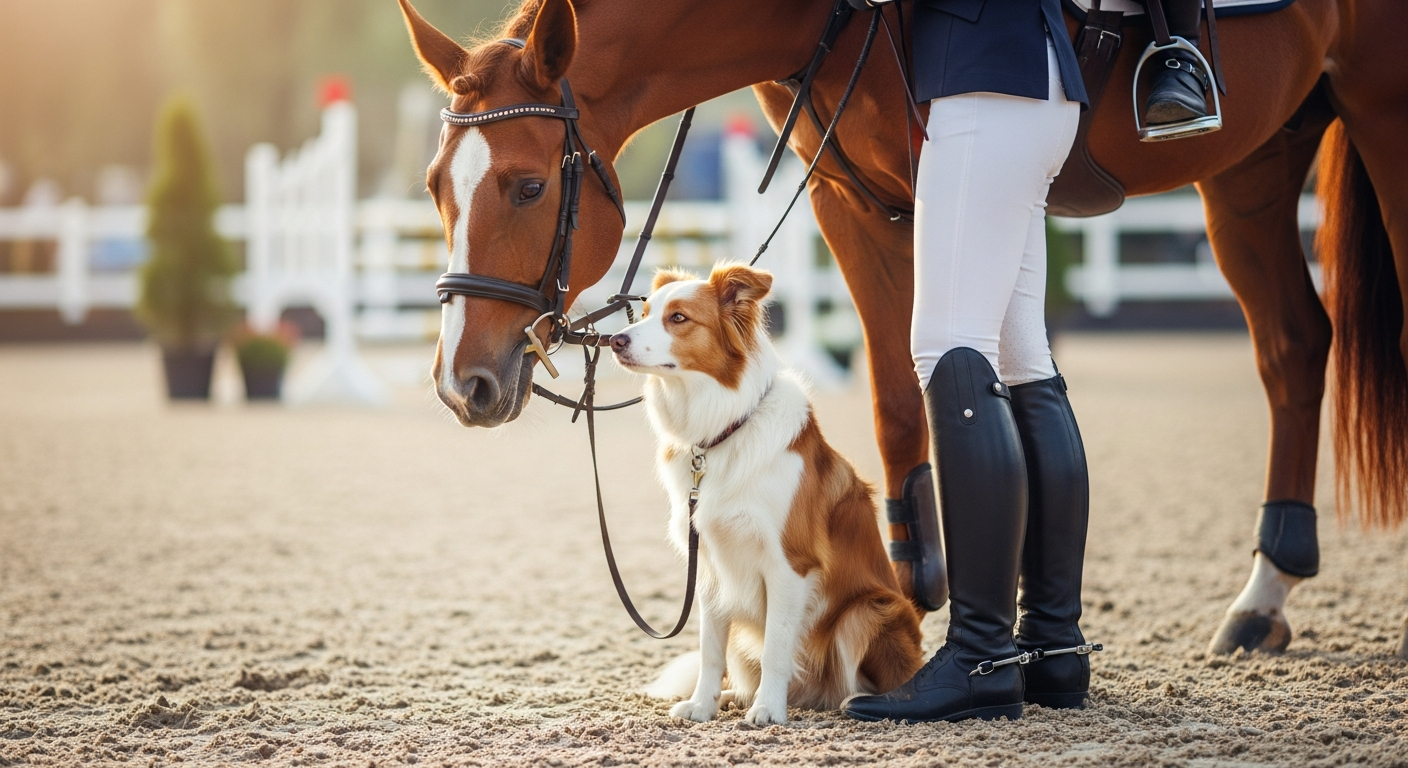
Horse shows are among the most stimulating environments a barn dog will encounter. Within a single afternoon, your dog may be exposed to hundreds of unfamiliar horses, busy warm-up rings, loudspeaker announcements, golf carts, tent flaps snapping in the wind, and crowds of strangers balancing food plates. Many dogs that behave impeccably at home will unravel at a show simply because the volume of stimulus exceeds anything they have ever practiced. The good news is that showing up prepared, and understanding the rules that govern dogs on competition grounds, makes the difference between a calm day together and a stewards' warning at the in-gate.
This guide pulls together the formal rules you need to know, the unwritten etiquette that experienced competitors live by, and the practical preparation that keeps barn dogs safe in crowded showgrounds. Before tackling show days specifically, it is worth reviewing the foundational work on introducing dogs to horses and the broader principles of barn dog safety, because a show is simply a barn dialled up to ten.
What the Rulebooks Actually Say
United States Equestrian Federation rule GR1301 requires that dogs on the competition grounds of a USEF-licensed competition be on a leash at all times, under the control of an adult, and never unattended. The rule applies to the stabling area, warm-up rings, schooling areas, and spectator areas. Dogs are explicitly prohibited from the competition ring during classes. Violations carry a fine that starts at two hundred dollars and can escalate with repeated offences, and show management has the authority to remove a dog from the grounds.
The Fédération Équestre Internationale takes a stricter position at CSI, CDI, and CCI events. Under FEI General Regulations Article 107, dogs must be kept on a leash at all times on the show grounds and are not permitted in the stabling area unless specifically authorised by the ground jury. Many Olympic and World Cup venues extend this further and exclude dogs from the show grounds entirely during the competition period. Always read the schedule published for the specific event rather than assuming the baseline rule applies.
National federations outside the United States often follow similar patterns. British Dressage, British Showjumping, and British Eventing all require dogs to be on leads no longer than two metres on their competition grounds. The Swiss, German, and French federations each publish their own versions, and at affiliated fixtures the venue may add further restrictions. The practical lesson is to check three sources before you travel: the federation rulebook, the schedule for the specific show, and any signage posted at the venue gate. If any one of them says no dogs, your dog stays home.
Verify Before You Drive
Call the show office the day before to confirm the dog policy. Policies can change between editions of the same fixture because of previous incidents, landowner requirements, or insurance changes. A two-minute phone call can save you a four-hour drive with a dog you cannot take inside the gate.
Warm-Up Ring and In-Gate Etiquette
The warm-up ring is where most dog-related incidents happen at horse shows. Riders in the warm-up are often over-adrenalised, focused on their own horse, and unable to react quickly to a dog that appears unexpectedly at the rail. A dog that lunges at the fence, barks at passing horses, or wraps its lead around a spectator's leg creates a predictable sequence: a horse spooks, a rider is unseated or loses a ride on a course, and the dog owner becomes the reason someone went to the medical tent. Read horse and dog body language before your first show so you can recognise rising tension in either animal.
Position yourself at least ten feet back from the warm-up ring rail, with your dog on the side of your body away from the ring. Use a standard six-foot leash rather than a retractable lead, because retractable leads fail under sudden load and create a trip hazard for anyone walking past. Keep the leash short enough that the dog cannot step into the path of a horse that is schooling near the rail. If your dog reacts to a passing horse, move further away immediately rather than correcting at the fence. Correcting at the fence teaches the dog that horses are the trigger for an unpleasant experience, which is the opposite of what you want for a long career together.
At the in-gate, dogs should be invisible. Gate stewards, course designers, and riders on deck are operating on tight timing, and a dog underfoot at the in-gate is a genuine hazard. If you are handling your rider's dog while they compete, stand well back from the gate and keep the dog sitting or lying down. A dog that whines or pulls toward a familiar horse in the ring distracts not only its own rider but every competitor nearby. If your dog cannot settle at the in-gate, take it back to the trailer area until your rider is finished.
Stabling Area Rules and Realities
Stabling aisles at multi-day shows are the functional equivalent of a busy small-town main street. Grooms are leading horses to and from wash stalls, farriers and veterinarians are moving between clients, golf carts are delivering shavings, and riders on horseback are walking to warm-up. A dog in this environment needs to be either on a leash under active control or secured in a crate inside the tack stall. Tying a dog to a chair, a tack trunk, or a stall front is not an acceptable alternative, because any of these can be dragged, knocked over, or opened by other people in the aisle.
Many shows publish a specific rule that dogs may not be left unattended in tack stalls overnight. This is partly for the dog's welfare, because an unfamiliar environment with no handler present can trigger barking that disturbs neighbouring horses, and partly because the insurance arrangements for the venue often do not cover loose dogs on the property outside show hours. Plan your accommodation so that a human is with the dog, or arrange a kennel nearby for the overnight portion of the stay.
The feed room, wash rack, and hay storage are all high-risk zones that parallel the hazards covered in our barn dog safety guide. At a show, the risk is elevated because the chemicals are unfamiliar, the spills have not been cleaned to the standard of a home barn, and the dog is already physiologically activated by the novelty of the environment. Keep your dog out of these areas unless you are actively supervising.
Preparing Your Dog for Show Day
The single most effective preparation is generalisation. A dog that has practised settling on a mat in fifty different environments will settle on a mat at a horse show. A dog that has only practised at home will meltdown. Start months before your first show by taking the dog to progressively busier environments: quiet parks, farmers' markets, outdoor cafés, and finally other people's barns during feeding time. Reward calm behaviour on the mat with a steady stream of low-value reinforcement, and remove the dog from the environment before it becomes overstimulated rather than waiting for a reaction.
Physical preparation matters too. A tired dog is a calm dog, so build in a long walk or a training session first thing on show morning before you unload horses. Bring more water than you think you need, because showground water bowls are often placed near high-traffic areas that stress dogs away from drinking. A cooling coat or wet bandana is sensible at summer shows where asphalt surfaces and black show tents create micro-climates well above ambient temperatures. The American Veterinary Medical Association notes that heat stroke in dogs can begin at a core temperature of 104°F, which corresponds to ground surfaces that feel merely warm to a human hand.
Pack a show day kit that lives in your trailer permanently. Include a six-foot leather or webbing leash, a backup leash, a two-bowl water setup with a one-gallon reservoir, a cooling mat, your dog's usual food with a spare day's ration, a muzzle sized and conditioned to the dog in case an emergency requires one, a copy of the dog's vaccination record, and a current photograph of the dog in case it goes missing on the grounds. The AKC publishes a good checklist for travelling with dogs at their dog travel safety guide that is worth reading once a year as a sanity check.
Handling the Unexpected
Even with preparation, shows produce situations your dog has never encountered. A child may approach without asking. A loose horse may come through the stabling aisle. A thunderstorm may roll in during a lunch break. Your job is to be the predictable element in the dog's environment. Stand still, keep the leash short and relaxed, and give your dog a clear direction such as a sit or a down. A dog that has been taught that your side is always the safest place will default to that position under stress.
If your dog does react badly, leave the environment without drama. A single bad experience is recoverable; a pattern of ignored thresholds produces a dog that associates horse shows with panic. Take the dog back to the trailer, give it a long-lasting chew, and reassess whether it is ready to return to the grounds that day or whether the better choice is to leave early. Experienced competitors understand that dogs have bad days, and nobody will think less of you for protecting your animal from a situation that exceeds its training.
Finally, remember that your behaviour at shows shapes the policies dogs enjoy on future entries. Every time a well-behaved dog is visible on the grounds, it reinforces to show management that responsible owners exist. Every time a dog creates an incident, it tightens the rules for everyone else. Treat your attendance as a small contribution to the long-term welfare of the horse-show dog community, and you will be part of why shows continue to welcome our canine companions.